
Khanh Hoa drives foreign investment into high-tech industries
Khanh Hoa is aligning FDI with the development of sectors in which it has advantages, with the aim of achieving double-digit growth while ensuring national defence and security safeguarding.
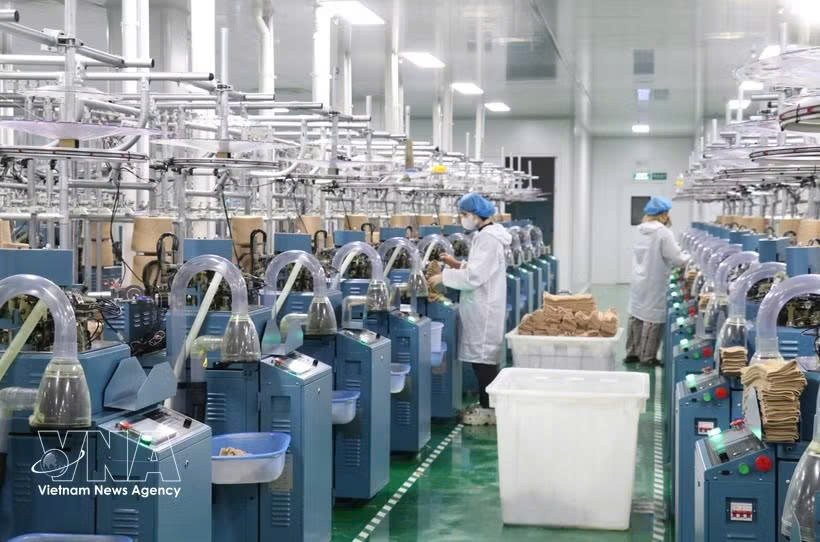
Aiming to sustain double-digit growth, the central province of Khanh Hoa is stepping up efforts to attract foreign direct investment (FDI), prioritising projects with high technological content and strong potential for deeper integration into value chains.
These projects are expected to open up new development opportunities, helping enhance production capacity, create jobs and accelerate the province’s economic restructuring.
Developing industry, supply chains
Van Phong Economic Zone is gradually establishing itself as one of Khanh Hoa’s key destinations for industrial investment. With its strategic geographical location, favourable seaport conditions and international trade connectivity, the area has considerable potential to develop large-scale industries, particularly shipbuilding and supporting industries.
The ship block manufacturing plant project of the Republic of Korea’s Miboo Heavy Industries has a total investment of 528.2 billion VND (20.43 million USD). Covering 12.7 ha in Ninh Thuy Industrial Park in Dong Ninh Hoa ward, the plant has an annual production capacity of 30,000 tonnes. It will manufacture blocks for new ships, a technically demanding field closely linked to the shipbuilding industry’s value chain.
Nguyen Van Trai, the plant’s director, said the company has received strong support from local authorities and relevant agencies in completing investment procedures. The project is expected to achieve a localisation rate of more than 70% and employ a large number of skilled Vietnamese workers.
HD Hyundai Vietnam Shipbuilding Co., Ltd. (HVS) is another example of how FDI can build industrial production capacity and create jobs. The Korean-invested company has operated in Khanh Hoa for three decades.
HVS currently employs more than 5,000 people, including around 3,000 working directly at the plant and over 2,000 employed by subcontractors. Its operations contribute more than 700 million USD to Khanh Hoa’s annual export turnover.
Attracting high technology investment
To implement Politburo Resolution No. 10-NQ/TW on developing the foreign-invested economic sector, Khanh Hoa has promptly translated its viewpoints, objectives, tasks and solutions into concrete measures. It is aligning FDI with the development of sectors in which it has advantages, with the aim of achieving double-digit growth while ensuring national defence and security safeguarding.
For 2026–2030, the province aims to attract around 500 million USD in registered foreign investment, equivalent to 100 million USD annually, and achieve cumulative disbursed investment of approximately 900 million USD, or 180 million USD a year. It targets projects from developed economies with strong technological capabilities and modern governance expertise, as well as foreign-invested enterprises possessing core or specialised technologies and the capacity to participate deeply in global value chains.
The Khanh Hoa Party Committee has also outlined plans to encourage the establishment of research and development (R&D) centres, innovation hubs, data centres and regional operations centres. Project selection must align with the provincial master plan for 2021–2030, with a vision to 2050, and the orientation of developing Van Phong Economic Zone into a national growth driver under Politburo Resolution No. 09-NQ/TW on the development of Khanh Hoa by 2030, with a vision to 2045.
Seizing investment opportunities, US-based HeMemics Biotechnologies Inc., Viet Khanh Joint Stock Company of Khanh Hoa and several other investors have formed a consortium to develop a high-tech graphene and biochip plant.
The plant will be located at Trang E 2 Industrial Cluster in Suoi Dau commune, covering more than 14,400 sq.m with total investment of approximately 390 billion VND.
The project targets strategic advances in high-tech manufacturing and research. In advanced materials, it will focus on producing graphene, a form of carbon known for its exceptional strength, for use in electronic components and biosensors. It will also expand the production of electronic components, biochips, sensor chips, microelectrodes, and specialised measuring and signal-reading devices. Technologies will be acquired and transferred from US partners before being progressively researched, refined and localised to suit manufacturing conditions in Vietnam.
Dr David Ho, founder, Chairman and Chief Scientific Officer of HeMemics Biotechnologies Inc. in Maryland, said gaining control over two-dimensional materials such as graphene will give Vietnam a highly distinctive strategic position. The ability to control materials at the molecular level will provide the country with the “key” to opening up entirely new fields of innovation.
A country capable of mastering graphene will have a decisive voice in global technology governance frameworks as the material is essential to energy security, including energy storage batteries and solar power, as well as healthcare security through biosensors, he said.
Source: VNA
Original link